
Why Polo Refuses to Be Influenced... and What That Says About Us
- Business of Polo (BoP)
- Jan 13
- 3 min read

Updated: Jan 14
Why the most exclusive sport in the world still refuses to over-perform for the crowd.
By Business of Polo Editorial Team
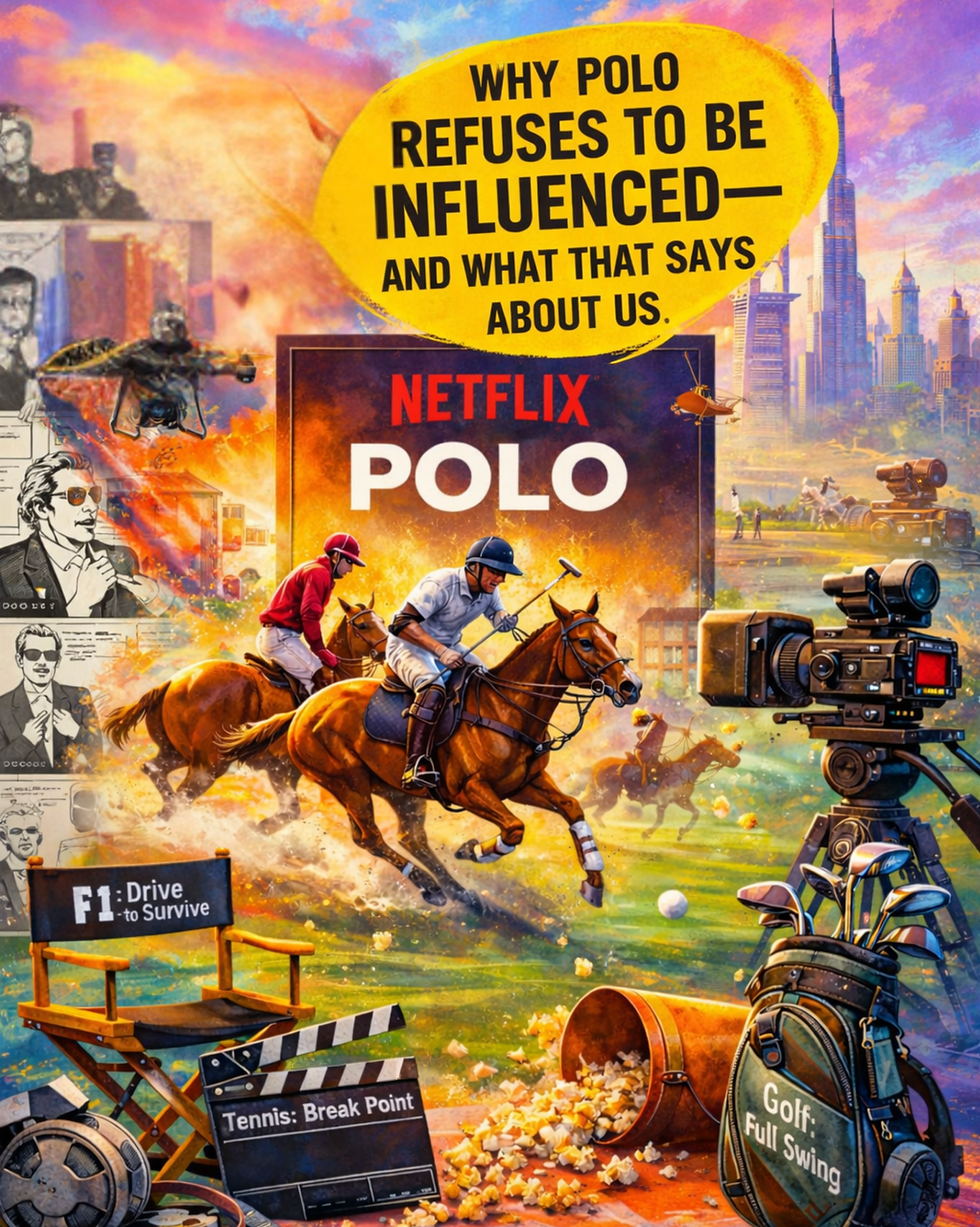
F1 got Drive to Survive. Tennis got Break Point. Golf got Full Swing. And then, polo got its own Netflix moment.
When Polo premiered on Netflix in late 2024, it had all the ingredients for a mainstream breakthrough: 4K drone footage, expensive sunsets, slow-motion chukkers, billionaires in linen. It was the first time the sport had been handed a global platform. Yet still, no one really talked about it. And maybe that’s the point.
The algorithm can’t decode silence.
Every luxury pastime has learned how to rebrand itself for public consumption. Formula 1 became reality TV with engines. Golf built a soap opera out of sand traps. Even sailing got a cinematic re-edit. Polo, on the other hand, never bothered.
Not because it can’t. Because it won’t.
In an era where visibility equals relevance, that stubborn refusal is either genius or suicide. The sport’s entire economy (patrons, bloodlines, and unspoken hierarchies) thrives on scarcity. You can’t trend in a world that measures worth by invisibility.
(Polo is played in 70+ countries, with participation estimated in the tens of thousands; golf participation is measured in the tens of millions - The R&A)
Even Netflix couldn’t make it go viral.
Polo should have been the gateway: the sport’s Drive to Survive moment. Instead, it trended for a weekend and disappeared. Critics called it “glossy but indecipherable,” a show about beautiful people and horses doing something the camera couldn’t quite explain.
That single sentence says everything. The sport’s mystery isn’t a production flaw, it’s the product.
Every frame of that series proved the same paradox: you can film polo, but you can’t translate it. The players are real, the horses are real, but the culture? It’s encrypted. A handshake between old money, new money, and no microphones.
Rebellion or irrelevance?
This is where the argument splits a field.
Purists will say exclusivity preserves integrity. Marketers will say it’s killing the sport. Both might be right.
Because polo’s secrecy is its brand strategy. You don’t watch polo; you gain access to it. It’s less broadcast, more initiation. And maybe that’s why it still feels rare in a world where everything else screams for attention.
But let’s ask the uncomfortable question: Would visibility really ruin polo or finally save it?
Imagine a Drive to Survive-style series about the Saudi desert season or Sotogrande summers: team politics, breeding rivalries, private-jet chaos. It could be cinematic gold or social death. Once you make mystery consumable, you kill the magic that made it valuable.
Privilege with better PR
The truth may be that polo’s unreachability isn’t rebellion at all. It’s simply privilege wearing a halo.
Every industry that hides behind exclusivity eventually hits a wall: the art world, couture fashion, fine wine. They all discovered that invisibility isn’t immunity. At some point, mystery turns into myth, and myths stop generating new believers.
The Netflix show exposed that fracture. It didn’t fail because it was bad; it failed because the ecosystem around polo isn’t built for translation. The rules, the money, the pace, the accents - nothing about it fits the viral grammar of modern media.
That’s either refreshing... or irrelevant.
“Every luxury industry claims to be exclusive. Polo actually means it. That’s either integrity or arrogance, depending on your handicap.”
What the rest of us secretly crave
Maybe that’s why the sport still fascinates us. In a world optimised for exposure, there’s something intoxicating about an experience that refuses to be understood.
Polo exists in a parallel economy of mystery. No hashtags, no commentators, no metrics. Just instinct, speed, and hierarchy. It’s the physical manifestation of something the digital age can’t replicate: grace without explanation.
And deep down, we miss that. We miss not knowing. We miss silence that doesn’t need subtitles.
The last real status symbol
Maybe polo isn’t noble for resisting exposure. Maybe it simply never learned how to be seen. But in an era where everyone’s broadcasting, being misunderstood has become the last real status symbol.
Every algorithm eventually chokes on mystery. And polo, somehow, still has it.
For more stories like this, follow @businessofpolo


Comments